The Healing Palette
Cognitive Regulation Through Art, Craft & Sensory Systems
A science-backed course that teaches students how to regulate their mind, sustain focus, and perform under pressure using art, craft and sensory tools.
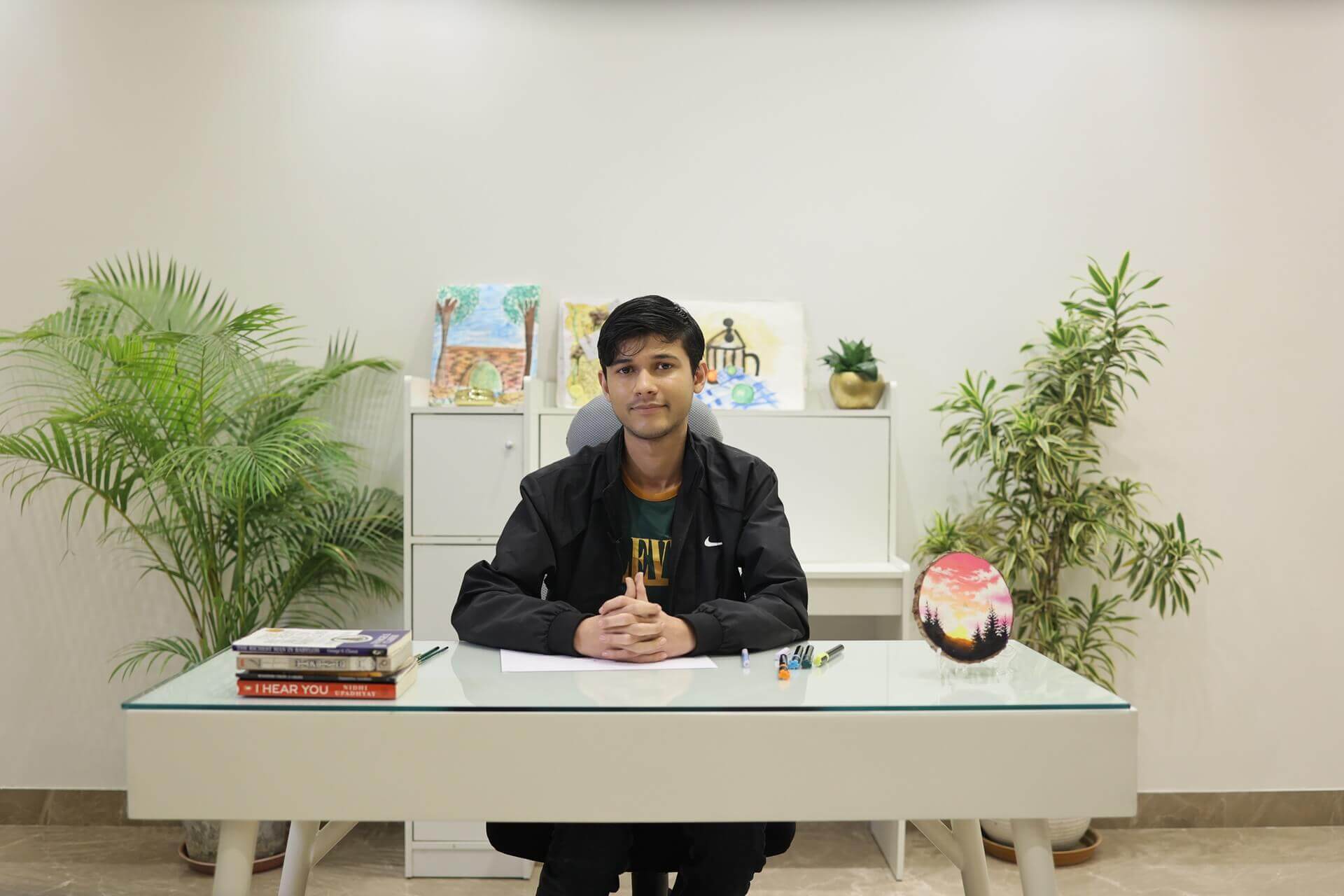
You are studying harder than ever.
Your mind is what is holding you back.
Nobody has told you that this is not a discipline problem. It is a cognitive regulation problem. And no amount of extra study hours will solve it.
I was putting in twelve hours a day. My brain would just stop cooperating the moment it mattered.
I knew the biology and chemistry. But under pressure in the exam hall, everything scrambled.
No one ever taught me how to manage what was actually happening inside my head.
What is The Healing Palette?
The Healing Palette is a self-paced video course on cognitive regulation designed for students preparing for board and entrance exams. Created by Farhan Khan, a Class 12 student at DAV Gian Prakash Chopra Public School, Faridabad, the course is built around one core insight: art, craft and sensory activity are not distractions from study. They are precision tools for mental performance.
This is not a motivation series. It is not a productivity hack. It is a structured, science-backed programme that teaches students how to read their own cognitive state, choose the right regulation tool for each moment, and build micro-habits that keep the mind sharp across the full length of an exam season.
Each module includes a focused video session and an e-book designed for students to revisit and apply throughout their preparation.
Designed by a student, during exam preparation, for students in exam preparation
Every technique is grounded in psychology and neuroscience research
Tools you can use today — before your next mock test or revision session
The focus is on cognitive effect, not artistic quality
No payment, no fees — built for students who are serious about mental performance
12 modules. No filler.
Built for exam season.
The course moves through two layers: foundational art-based regulation techniques, and practical cognitive tools designed for the demands of high-pressure exam preparation and high-stakes performance.
You Are Not Underprepared. Your Brain Just Needs a Reset.
Most students believe exam stress is an emotional problem. It is not. This module reframes how you understand your own mind and sets the foundation for everything that follows.
Watercolour Mindfulness: Breaking Mental Rigidity
Learn how the flowing quality of watercolour dissolves exam anxiety and restores cognitive flexibility. This module explains the science behind why unstructured creative movement loosens rigid thinking under the pressure of exam preparation.
Doodling Focus: Attention Without Effort
Struggling to concentrate during long revision sessions? This module reveals how simple doodling stabilises attention without adding mental load. Repetitive, low-pressure drawing helps the brain stay engaged and reduces cognitive overload.
Slow Ink: Regaining Control Through Calligraphy
When thoughts feel chaotic before an exam, slowing down your writing can restore clarity. This module shows how calligraphy acts as a mental anchor, helping you organise scattered thinking and reduce anxiety by intentionally slowing language and movement.
Structured Creativity: Beating Decision Fatigue with Acrylics
Too many choices exhaust the mind during revision. This module uses acrylic painting to train clearer decision-making. Its layered, structured nature teaches the brain to reduce overwhelm and regain cognitive control under pressure.
The Art of Closure: Breaking Mental Loops with Resin
Do your thoughts keep circling the same worries the night before an exam? Resin art teaches the psychology of completion. This module explores how creating something permanent helps the brain let go, find closure, and reduce overthinking before high-stakes moments.
Reset and Rewire: Finding Mental Coherence After Pressure
After prolonged study sessions and mock tests, the mind needs a structured reset. This module brings all previous techniques together to help you rebuild clarity, restore balance, and reconnect fragmented thinking into a calm, focused state.
The Stress Trap: Understanding Exam Stress and Standing Out Under Pressure
Exams test mental performance, not just content knowledge. This module dives into the psychology of exam stress and teaches you how to stay composed, think clearly, and stand out under pressure in board and entrance exams.
Still the Mind, Move the Pen: Mandala, Rhythm and Emotional Reset
This module explores the science behind mandala art, rhythm, and psychological regulation. Repetitive, patterned movement is one of the most powerful tools for emotional balance studied in modern neuroscience. No art skills required. No meditation experience needed.
The Habit That High-Scoring Students Use to Stay Calm Before Exams
Your teachers told you to put the pencil down. Science says pick it back up. This module explains why art and craft are among the most effective stress-regulation tools available to students, and how just ten minutes of creative activity before an exam can shift your nervous system from panic to focus.
Your Five Senses Can Beat Exam Anxiety: Here Is Exactly How
You have tried deep breathing. You have tried positive thinking. This module teaches how sensory-based art and craft activities directly regulate your nervous system, and why this is especially powerful during high-stakes entrance exam preparation.
Why Studying Harder Is the Wrong Answer: Read Your Mind First
Most students sit down to study without asking one critical question: what state is my brain actually in right now? This module teaches you to read your own cognitive state before every session and match your practice to what your mind actually needs.
The 5-Minute Habits That Keep High Scorers Mentally Stable All Year
Big routines collapse under the pressure of exam season. This module explains why micro-regulation — small and consistent daily habits — is what actually keeps students mentally sharp from the first week of preparation through to exam day. Not willpower. Not motivation. Just the right practices, done at the right time.
12 modules. E-books included. Completely free.
Start building your cognitive regulation toolkit today — before your next exam.
You will leave this course with a mind
you know how to work with.
Cognitive clarity under pressure
You will understand exactly what is happening in your brain when exam stress builds, and know precisely what to do about it.
A toolkit that actually works
Practical, science-backed techniques using watercolour, doodling, calligraphy, resin and more — ready to deploy on exam day.
The ability to reset quickly
You will know how to shift your mental state in minutes, not hours, when you feel overwhelmed during revision or mock tests.
Habits that survive bad days
Micro-regulation practices that do not require motivation or a perfect routine to work — even during the hardest weeks of exam preparation.
Attention that you can direct
You will understand attention stability and how to hold focus without force, even through the longest study sessions.
Closure on looping thoughts
A framework for completing mental cycles so you stop carrying yesterday's stress into today's revision.
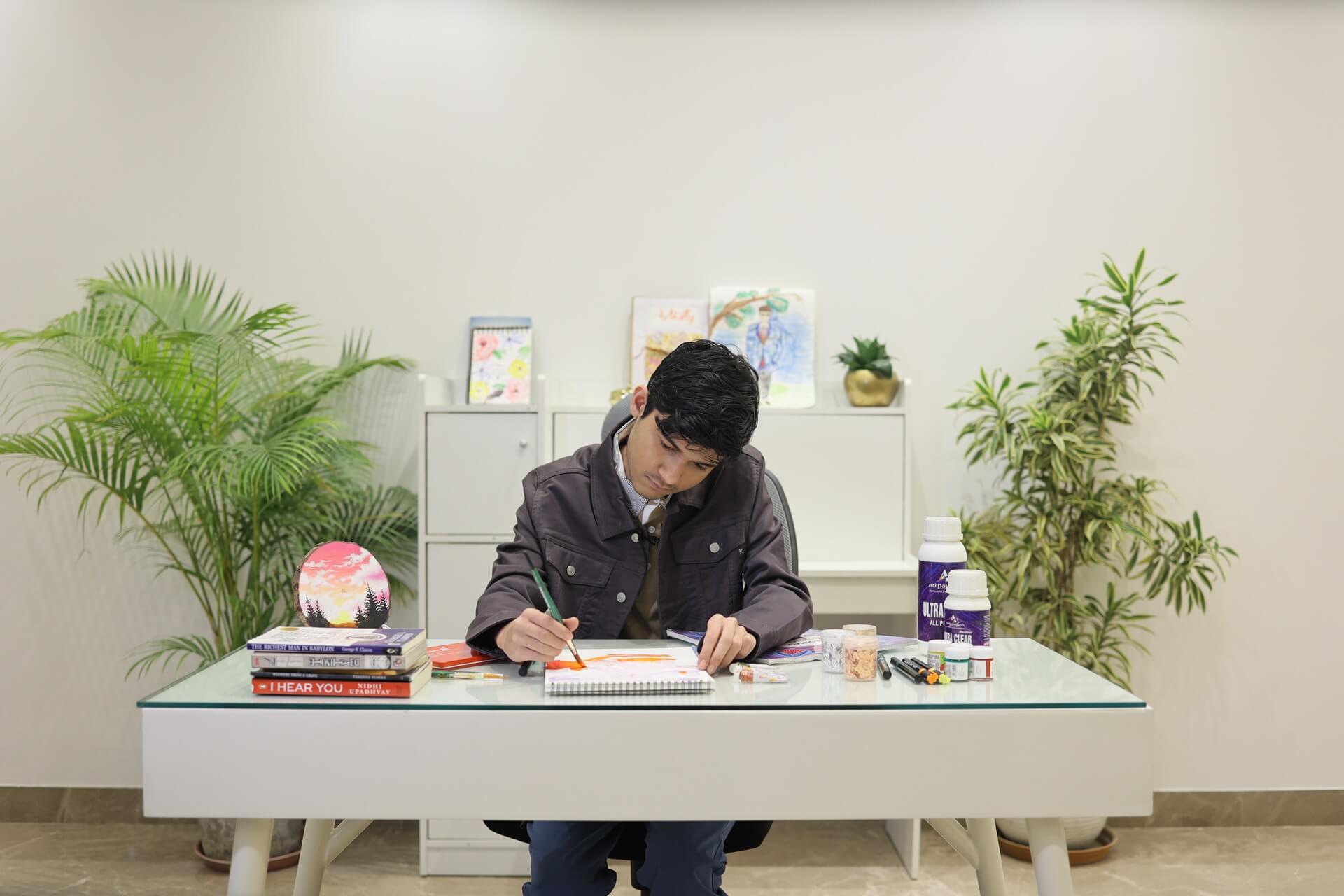
Farhan Khan
Class 12 . DAV Gian Prakash Chopra Public School. Faridabad, India
Farhan Khan is a 17-year-old student whose passion for medicine is matched by an equally serious commitment to understanding how the adolescent mind performs under pressure. Since deciding at the age of 14 to pursue medicine, he has observed a pattern that few students acknowledge openly: the gap between what students know and what they demonstrate on exam day is almost never about preparation. It is about mental regulation.
That observation became the foundation of The Healing Palette. Farhan designed this programme from within the lived experience of exam preparation itself, drawing on his own practice in art, his reading in psychology and neuroscience, and the personal work he undertook to manage academic overload, communication challenges, and the emotional demands of high-stakes preparation.
Beyond the course, Farhan has channelled this understanding into MindOverMarks, his broader initiative for cognitive wellbeing among adolescents — a mental wellness strengthening programme designed to help students build high performance through mental clarity.
“I have seen how difficult it is for teenagers to manage stress, distraction, and emotional overload. We are constantly expected to focus and perform, yet no one teaches us how to actually regulate our thoughts and emotions. This course is my answer to that — built from the inside of exam preparation itself.”
Why does The Healing Palette exist?
The Indian education system teaches content at scale. It does not teach students how to manage the cognitive load, the emotional pressure, or the attentional demands that come with high-stakes exam preparation. The result is a generation of capable students who are academically prepared but mentally under-equipped for the pressure they face.
“Cognitive regulation is not a luxury for high performers. It is the foundation that high performance is built on.”
No fees. No hidden charges. Built for students who are serious about their mental performance.
Real experiences. Real students.
“I never thought something as simple as drawing could actually help me focus during revision. But it genuinely does. I use the doodling technique before every study session now. It takes five minutes and the difference in my concentration is real. I wish I had known about this sooner.”
A few honest answers.
Your mind is not the problem.
It just needs the right tools.
The Healing Palette gives you those tools.
Science-backed, student-tested, and ready to use from the very first week. Every day you study without these regulation tools is a day your preparation works at a fraction of its potential. The course is here. It is free. And exam season does not wait.
Enroll in The Healing Palette
Complete the form below to get instant access to all 12 modules, e-books, and cognitive regulation tools.
Zero Risk. Zero Cost. Full Access.
The Healing Palette is completely free. There is no payment page, no upsell, no hidden fees. You get full access to all 12 modules, all e-books, and all cognitive tools the moment you enroll. This course was built for students, by a student — and it will stay free. Your only investment is your attention and your willingness to approach exam preparation differently.